Samsung Galaxy S26 FE vs S25 FE: Which Phone Offers Better Value?
The Galaxy S26 FE arrives with a higher price tag and a new 3nm Exynos 2500 chipset. We compare it to the S25 FE to see if the upgrade is worth your money.
By Tradifox Editorial· 5 min read
This article was generated with AI from the sources it names. Report an error

Evaluating Samsung's Fan Edition Value Equation
Samsung's Fan Edition series has historically targeted shoppers looking for flagship capabilities at a palatable discount. However, macroeconomic shifts and rising component costs across the electronics sector have challenged that formula. The Galaxy S26 FE enters the market at a €50 or $100 price increase over its predecessor, despite sharing a nearly identical structural footprint.
Because the underlying hardware blueprint has changed very little between generations, potential buyers face an important question. Determining whether the newer model warrants its higher asking price requires examining the real-world impact of its upgraded silicon against the discounted Galaxy S25 FE.
Design, Chassis Dimensions, and Materials
In terms of physical construction, the Galaxy S26 FE and S25 FE are practically twins. Both smartphones use Samsung's Enhanced Armor Aluminum frame, sandwiched between sheets of Corning Gorilla Glass Victus+ on the front and rear panels. This structural parity means durability and in-hand tactile quality remain consistent regardless of which device you hold.
Dimensional variances between the two handsets are measured in fractions of a millimeter. The Galaxy S26 FE measures 161.6 x 76.9 x 7.4 mm and registers at 193 grams on the scale. In comparison, the Galaxy S25 FE comes in at 161.3 x 76.6 x 7.4 mm and weighs 190 grams. This minor three-gram difference is imperceptible in ordinary daily handling.
Aesthetic differences are largely restricted to exterior finishes. Samsung retired the previous palette of Icyblue, Jetblack, Navy, and White in favor of fresh options for the S26 FE, including Blueberry, Graphite, and Pistachio. Aside from those new shades, neither phone offers a distinctive visual upgrade over the other.
Display Panels and Acoustic Performance
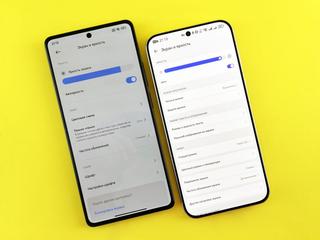
Viewing experiences across both generations are virtually indistinguishable. Both handsets feature a 6.7-inch OLED panel operating at a 120Hz refresh rate with a resolution of 1080x2340 pixels, yielding an identical pixel density of 385 ppi. Screen real estate, sharpness, and motion handling remain equivalent in typical viewing scenarios.
Lab measurements confirm that panel luminance has seen almost no change between iterations. The Galaxy S26 FE achieves a peak brightness of 1268 nits under bright ambient light, compared to 1247 nits recorded on the S25 FE. This negligible 21-nit variance offers no visible advantage during bright outdoor usage.
Acoustically, both devices employ a standard stereo loudspeaker arrangement. Interestingly, acoustic output tests show the older Galaxy S25 FE actually produces slightly louder maximum volume than the S26 FE. However, overall frequency balance and vocal clarity remain equivalent on both devices.
Silicon Architecture: Exynos 2500 vs Exynos 2400
The central architectural divergence between these two phones lies in their processor design. The Galaxy S25 FE relies on the 4 nm Exynos 2400 platform, a capable chip originally launched in 2024. In contrast, the Galaxy S26 FE transitions to Samsung's newer 3 nm Exynos 2500 chipset, bringing architectural improvements to overall compute efficiency.
Despite the architectural revision under the hood, memory configurations remain entirely uniform across both lineups. Both devices start with 8 GB of RAM paired with 128 GB of internal flash storage. Users requiring extra room can also configure either phone with 256 GB or 512 GB capacities.
In day-to-day multitasking, app launches, and interface navigation, the perceived responsiveness gap between the two chipsets is minimal. Both systems handle heavy workloads and graphic processing without significant thermal bottlenecks. The primary advantage of the newer 3 nm process node lies in operating efficiency rather than sheer computing power.
Battery Endurance and Charging Comparisons
Battery capacity remains identical on paper, with both phones incorporating a 4900 mAh cell. However, this is where the node advantage of the Exynos 2500 makes a tangible impact. The refined 3 nm architecture delivers lower continuous power draw during screen-on tasks like video streaming and continuous web browsing.
These architectural savings translate into demonstrably higher Active Use Scores for the Galaxy S26 FE. Users who spend extensive time away from wall outlets will observe slower battery drain during prolonged multimedia and browsing sessions. For efficiency-conscious consumers, this represents the single concrete functional upgrade in the newer model.
Charging performance, on the other hand, yields practically identical results between models. Both support Samsung's 45W wired charging protocol. The Galaxy S26 FE recovers 40% battery capacity in 15 minutes and achieves a full recharge in 68 minutes, while the S25 FE reaches 36% at the 15-minute mark and finishes a complete charge in 70 minutes.
Value Assessment and Final Recommendation
Evaluating the broader value equation highlights the difficult position of the Galaxy S26 FE. At a €50 or $100 price hike, the newer model charges a clear premium while keeping the screen, chassis, camera setup, and charging speeds largely unchanged. The price increase is largely driven by surging memory chip costs rather than groundbreaking hardware additions.
The S26 FE remains worth considering primarily for buyers who require the best possible single-charge battery life from their device. For anyone else, the older Galaxy S25 FE provides virtually the same physical build, identical display performance, and capable processing power at a meaningfully lower price.
Frequently Asked Questions About Galaxy S26 FE and S25 FE
Why is the Galaxy S26 FE priced higher than the S25 FE?
The Galaxy S26 FE carries a $100 (€50) launch premium over its predecessor, primarily driven by rising memory component costs. Despite this price hike, internal storage and RAM tiers remain identical to the previous generation.
What performance upgrade does the Exynos 2500 processor provide?
The Galaxy S26 FE upgrades to the 3 nm Exynos 2500 chipset, offering improved power efficiency over the 4 nm Exynos 2400 in the S25 FE. This results in longer endurance during web browsing and video playback.
Should existing Galaxy S25 FE owners upgrade to the S26 FE?
Upgrading is hard to justify for current S25 FE owners. Both phones use identical 4900 mAh capacities, identical 45W charging speeds, and matching 6.7-inch OLED panels with nearly equivalent peak brightness.
Are there noticeable design or build quality differences?
Both handsets feature Armor Aluminum frames and Gorilla Glass Victus+ on both sides. The Galaxy S26 FE is merely 3 grams heavier and introduces fresh finishes like Blueberry, Graphite, and Pistachio.
Related articles