How Much Power Can a 1kW Wind Turbine Produce for Your Home?
A 1kW residential wind turbine might sound like enough for a small home, but peak capacity isn't continuous. Learn the realities of home wind generation, zoning issues, and output.
· 8 min read
This article was generated with AI from the sources it names. Report an error
Measure Local Wind Speeds and Site Potential
Evaluating whether a 1kW wind turbine makes economic and practical sense starts with understanding your property's wind profile. While residential wind systems offer an appealing off-grid or supplemental clean energy alternative, they require substantial and consistent air movement to generate meaningful electricity. Assessing this resource accurately prevents costly investments in locations where turbine blades rarely reach efficient operational speeds.
Establish the Baseline Speed Threshold
Investing in residential wind generation requires an annual average wind speed of at least 14 mph to remain viable. Turbines require a baseline velocity to initiate blade rotation and overcome internal mechanical resistance. Because usable power increases exponentially with wind velocity, even minor drops below this benchmark severely diminish real-world electrical production.
Wind speeds below 10 mph produce virtually negligible power, regardless of the system's nominal nameplate capacity. Even an efficient 1kW design requires brisk, steady gusts to reach its maximum electrical rating.
Access Regional Wind Resource Databases
Begin your assessment by consulting regional databases compiled by the National Renewable Energy Laboratory and state energy offices. These repositories provide localized wind resource maps that estimate average velocities at specific altitudes across geographical areas. Reviewing these figures offers a high-level reality check on regional air currents before you invest in hardware.
Regional maps rely on data recorded by local airports and weather stations, which often sit on flat, open terrain. Because localized topography alters surface airflow, these datasets establish general feasibility rather than site-specific guarantees.
Deploy On-Site Anemometer Hardware
Gathering definitive site data requires installing a recording anemometer directly on your parcel for several months to a full year. Place the sensor at the planned installation height to account for ground friction, which significantly degrades low-altitude airflow. Continuous data collection captures seasonal shifts and wind lulls that broad regional estimates typically miss.
Dedicated data loggers record gust frequency, sustained velocities, and prevailing wind directions. Analyzing these localized figures ensures that physical tower placement maximizes capture while avoiding turbulent wind patterns created by nearby obstructions.
Review Local Zoning Regulations and Tower Setbacks
Installing a residential wind turbine requires navigating municipal property codes long before ordering hardware. Local building departments govern vertical structures to protect neighborhood safety and minimize visual impact. Understanding local restrictions early prevents costly permitting denials or compulsory equipment removal.
Check Municipal Structure Height Limits
Most municipal residential zoning codes impose strict height caps, often limiting accessory structures to 35 feet. This rule creates a direct obstacle for residential wind generation. Wind speeds increase significantly at higher altitudes, while near-ground airflow remains turbulent and weak.
The US Department of Energy recommends mounting the lower edge of the turbine rotor at least 30 feet above any obstacle within 300 horizontal feet. Achieving this clearance is difficult in standard subdivisions bounded by mature trees and multi-story homes. Exceeding local height limits requires securing a formal zoning variance, which involves public hearings and neighbor notifications.
Calculate Boundary Setback Requirements
Setback rules dictate how far a tower must stand from property lines, utility easements, and occupied buildings. Many municipalities enforce fall-zone setbacks equal to 110 to 150 percent of the system's total height, measured to the tip of the highest blade. A 60-foot tower may require a 90-foot perimeter buffer in every direction.
These boundary buffers make small suburban parcels unsuitable for freestanding towers. Properties smaller than one acre rarely provide the physical room to satisfy standard setback mandates. Failing to prove adequate property margins will lead planning commissions to reject building permits.
Review HOA Covenants and Noise Ordinances
Beyond city codes, private homeowner association rules frequently prohibit residential wind hardware outright. Even when local ordinances permit towers, private covenants can restrict any equipment visible above the roofline. You must review your deed restrictions before investing time into engineering surveys.
Municipal decibel limits also influence turbine placement. Most residential areas enforce noise ceilings between 45 and 55 decibels at the property boundary during nighttime hours. While modern 1 kW turbines use aerodynamic blade designs to limit acoustic output, close proximity to property borders can still trigger neighbor complaints and zoning enforcement.
Audit Household Electrical Consumption Against Realistic Output
Determining whether a micro wind setup makes sense requires balancing residential demand against actual energy capture. While equipment marketing frequently emphasizes a turbine's nameplate peak capacity, that figure represents maximum generation under optimal conditions rather than continuous output. Measuring past utility records against realistic generation reveals the true scope of small-scale wind.
Review Monthly Utility Bills and Base Usage
Begin by collecting twelve consecutive months of electric bills to calculate your home's total demand. The typical American residence consumes roughly 10,500 kilowatt-hours annually, which breaks down to approximately 850 kilowatt-hours per month. These figures fluctuate significantly based on seasonal climate controls, electric water heating, and daily appliance usage.
Establishing an average monthly baseline allows homeowners to separate essential background loads from intermittent peaks. Tracking these numbers reveals whether clean generation can reliably offset primary consumption or merely reduce minor grid draw.
Calculate Realistic 1kW Turbine Generation
A 1kW turbine rating only reflects output during sustained high winds, usually around 25 to 30 mph. In an optimal location with consistent annual wind speeds of 14 mph or higher, a well-sited 1kW unit realistically produces about 200 kilowatt-hours per month, totaling roughly 2,400 kilowatt-hours each year.
Comparing this output against average household demand shows that a single 1kW unit covers less than one-quarter of standard residential electricity needs. The remaining three-quarters must still come from traditional grid power or an auxiliary clean energy source.
Size the System for Actual Energy Goals
Because a 1kW unit yields modest production, it functions best as a supplemental power source for specific secondary circuits or off-grid cabins rather than a whole-home replacement. Fully offsetting an entire standard home's energy footprint requires a substantially larger turbine array, typically rated between 5kW and 15kW.
Grid-connected installations also require dedicated inverters to synchronize alternating current with incoming utility lines. For off-grid configurations, homeowners must budget for deep-cycle storage batteries and a charge controller to harvest intermittent gusts into usable, continuous reserves.
| Energy System Option | Typical Capacity | Annual Output Potential | Average Setup Cost |
|---|---|---|---|
| 1kW Micro Wind Turbine | 1 kW rated peak capacity | Around 2,400 kWh annually | $3,000 to $8,000 installed |
| Whole-Home Wind Turbine | 5 kW to 15 kW peak capacity | 9,000 to 15,000+ kWh/year | $20,000 to $50,000 installed |
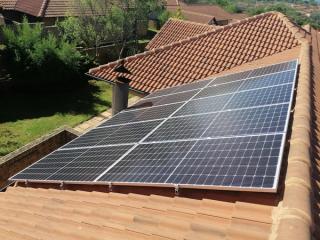
| Equivalent Solar Array | 2 kW residential rooftop | Around 2,400 to 3,000 kWh/yr | $2,500 to $3,500 pre-credits |
| Whole-Home Solar System | 6 kW to 10 kW rooftop array | 9,000 to 14,000 kWh/year | $18,000 to $25,000 pre-credit |
Select Electrical Components for Grid-Tied or Off-Grid Architectures
Converting raw kinetic power into usable electricity requires matching your 1 kW turbine with the right power electronics. A wind generator produces variable alternating or direct current that shifts constantly with wind speed, meaning you cannot plug home appliances directly into the tower. Deciding between a utility-connected feed and an independent storage setup determines the necessary balance-of-system hardware.
Pair with Grid-Tied Inverters for Direct Net Metering
Grid-connected configurations channel turbine output straight into your residential breaker panel, supplementing your utility supply in real time. This pathway requires a specialized grid-tie wind inverter, which constantly synchronizes electrical frequency and voltage with the local grid. If your 1 kW unit generates excess power, the balance flows outward to spin your meter backward under local net metering rules.
However, standard grid-tied setups do not provide emergency backup during municipal blackouts. Utility regulations mandate that grid-interactive inverters shut down instantly when the central grid drops, preventing hazardous electrical backfeeding into transmission lines. Homes that prioritize uninterrupted power during severe storms must add expensive automatic transfer switches and hybrid inverters.
Integrate Charge Controllers and Battery Banks for Off-Grid Resilience
Off-grid installations depend on dedicated storage banks to capture energy during gusty periods for use during calm spells. Operating this setup requires a dedicated wind charge controller that rectifies wild power output and regulates voltage before it reaches the batteries. This unit prevents overcharging and uses an automated dump load—often a high-resistance heating coil—to safely bleed off surplus energy when batteries fill during heavy winds.
Selecting your battery chemistry dictates overall storage efficiency and usable lifespan. Deep-cycle lithium iron phosphate (LiFePO4) packs cost more upfront than lead-acid alternatives but deliver deeper discharge thresholds and endure thousands of cycles without rapid degradation. Downstream from the bank, a pure sine wave off-grid inverter converts stored direct current into standard 120-volt household power.
Balance Component Costs and System Complexity
Choosing your hardware profile significantly influences total balance-of-system expenses. A grid-tied arrangement minimizes mechanical equipment by avoiding chemical batteries, keeping ongoing maintenance down to electrical inspections and inverter servicing. Off-grid systems demand continuous investment in battery monitoring, ambient temperature control, and eventual cell replacements to sustain reliable off-grid capacity.
Essential Practices for Wind Turbine Siting and Equipment Longevity
Maximize electrical output and protect hardware reliability by positioning your residential turbine for steady airflow and minimal mechanical turbulence.
- 1
Clear nearby obstacles using the standard thirty-foot height rule.
Turbulence dramatically degrades turbine power generation and accelerates mechanical wear on the bearings and alternator. Adhering to the Department of Energy standard ensures blades encounter clean, laminar airflow across changing seasons.
Keep the rotor blades at least 30 feet above any obstacles situated within 300 horizontal feet. Elevating the tower above surrounding treelines and outbuildings delivers reliable generation while preventing gust-induced structural stress.
- 2
Use standalone towers instead of rooftop mounts to eliminate noise.
Attaching a small turbine directly to a home roof transfers continuous low-frequency vibrations and acoustic drone into structural rafters. This installation method often places blades directly into unstable updrafts curling off the roofline.
Always select a standalone guyed or freestanding tower away from living spaces. Freestanding placement completely eliminates indoor vibration transfer and lets the turbine capture uninterrupted wind speeds.
Home Wind Turbine Pre-Installation Readiness Checklist
Review these essential site conditions, zoning regulations, and hardware requirements before purchasing a residential wind turbine system.
- Confirm that your property experiences sustained annual average wind speeds of at least 14 mph.
- Review local municipal zoning laws and HOA bylaws regarding structural height limits above 35 feet.
- Map obstacle clearances to ensure the rotor blade tip sits at least 30 feet above nearby tree lines.
- Decide between a grid-tied inverter setup and dedicated battery storage with a charge controller.
- Select a freestanding tower site away from the main home to prevent rooftop structural vibration.
Frequently Asked Questions About Home Wind Turbines
Can a 1kW wind turbine fully power an average home?
A 1kW turbine generates roughly 200 kWh monthly in strong wind conditions, yielding about 2,400 kWh annually. Because typical US homes use approximately 10,500 kWh each year, this output covers less than a quarter of normal residential power needs.
Why are residential wind turbines difficult to install in urban areas?
Turbines require steady wind averaging at least 14 mph to remain viable. Buildings and trees create turbulence that drops electrical output and increases mechanical wear, while municipal 35-foot height limits prevent towers from reaching clean air.
Can you safely mount a small wind turbine directly to your roof?
Direct rooftop mounting is not recommended. Turbines vibrate continuously during operation, which transmits distracting structural noise into living spaces. Rooftop installations also suffer from severe wind turbulence caused by the roofline itself.
How does the payback period of home wind compare to solar?
Small wind installations often have prolonged payback periods due to high upfront costs ranging between $20,000 and $50,000. Equivalent solar panel setups cost approximately $2,500 to $3,500 before incentives, offering superior financial returns.